
Description
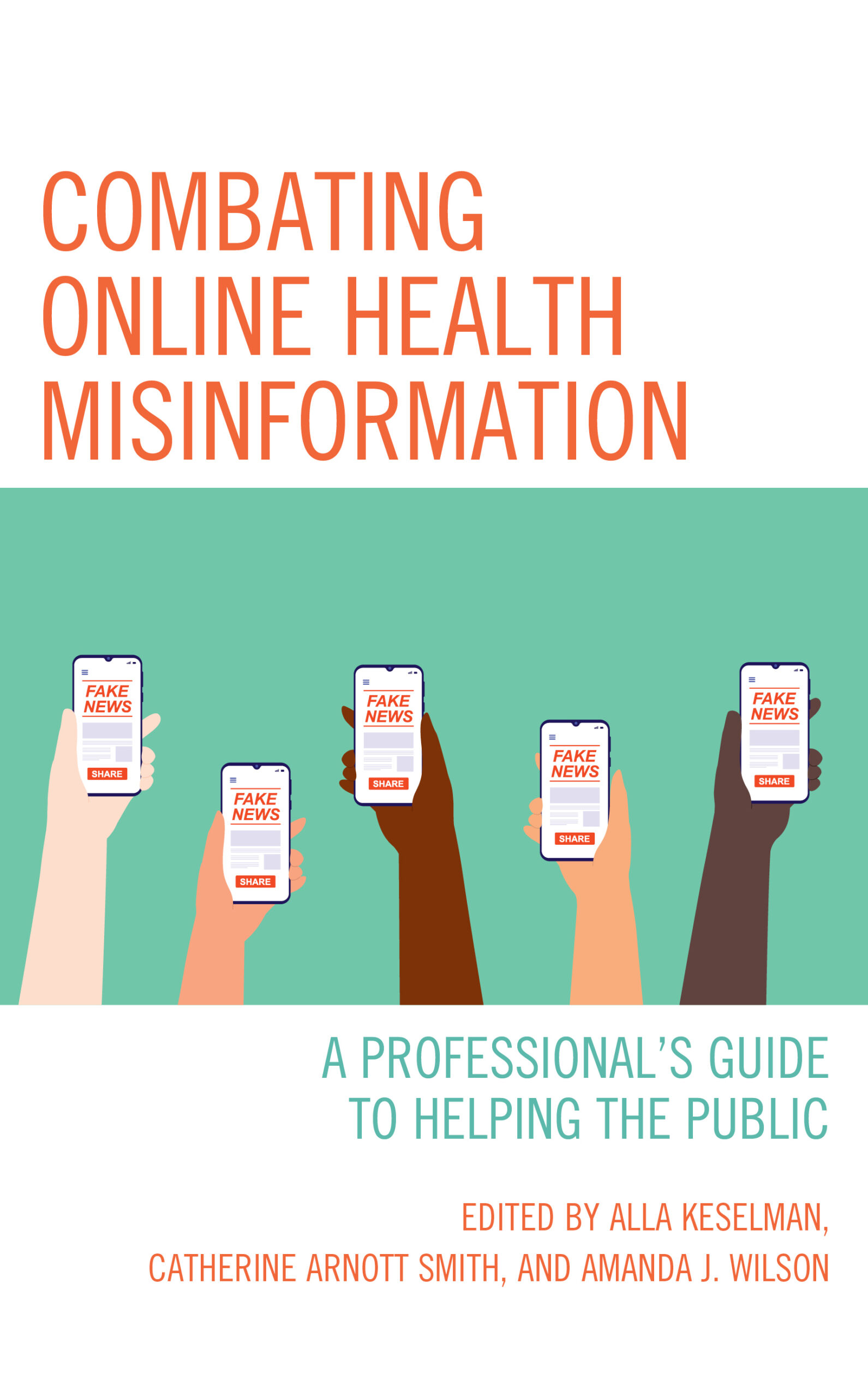
Combating Online Health Misinformation
A Professional’s Guide to Helping the Public
Rowman & Littlefield Publishers
Danger of health misinformation online, long a concern of medical and public health professionals, has come to the forefront of societal concerns during the COVID-19 pandemic. Regardless of their motives, creators and sharers of misinformation promote non-evidence-based health advice and treatment recommendations, and often deny health methods, measures, and approaches that are supported by the best evidence of the time. Unfortunately, many infrastructural, social, and cognitive factors make individuals vulnerable to misinformation.
This book aims to assist information and health professionals and educators with all phases of information provision and support, from understanding users’ information needs, to building relationships, to helping users verify and evaluate sources. The book can be used as a textbook in library and information science programs, as well as nursing, communication, journalism, psychology, and informatics programs.
The book, written from the e-health literacy perspective, is unique in its nuanced approach to misinformation. It draws on psychology and information science to explain human susceptibility to misinformation and discusses ways to engage with the public deeply and meaningfully, fostering trust and raising health and information literacy.
It is organized into three parts.
Part I: The Ecology of Online Health Information’ overviews the digital health information universe, showing that misinformation is prevalent, dangerous, and difficult to define.
Part II: Susceptibility to Misinformation: Literacies as Safeguards addresses factors and competencies that affect individual vulnerability and resilience.
Part III: Solutions focuses on education and community engagement initiatives that help the public locate and evaluate health information.
Chapters within the three Parts discuss technological innovation and social media as posing novel risks as well as presenting novel solutions to helping the public connect with high quality information and building trusting relationships among the public and information and health professionals.
About the Editors
Catherine Arnott Smith, PhD, is Professor in the Information School and a Discovery Fellow, Virtual Environments Group, Wisconsin Institutes for Discovery, University of Wisconsin-Madison. She is a former medical librarian who moved into biomedical informatics for her PhD through the Center (now Department) of Biomedical Informatics at the University of Pittsburgh (2002), where she was a National Library of Medicine medical informatics predoctoral trainee. Her research centers on consumer interactions with clinical information systems, mediated through text, in settings that range from patient portals to public libraries to disabilities support centers.
Alla Keselman, PhD, is a Senior Social Science Analyst in the Office of Engagement and Training, National Library of Medicine, Bethesda, MD. She holds a PhD in human cognition and learning and an MA in biomedical informatics from Columbia University. Dr. Keselman coordinates NLM efforts in evaluating the impact of its health information outreach and community engagement programs. Her research interests include lay understanding of complex health concepts, scientific literacy, and the provision of health information outside clinical settings. She has done work on bringing health and environment-related topics to the science classroom and conducted research into the role of libraries in providing health information to the public.
Jointly, Dr. Catherine Arnott Smith and Dr. Alla Keselman co-edited “Meeting Health Information Needs Outside Of Healthcare: Opportunities and Challenges” (2015, Elsevier) and co-wrote “Consumer Health Informatics: Enabling Digital Health for Everyone” (in press Dec 2020, Chapman & Hall).
Amanda J. Wilson, MLS, is Chief, Office of Engagement and Training (OET) at the National Library of Medicine. She holds a MS in Library Science from the University of North Carolina at Chapel Hill and a BA in music and psychology from Emory University. OET brings together the general engagement, training, and other outreach staff from across the library whose primary focus has been on the Library’s presence across the U.S. and internationally, and coordinates the National Network of Libraries of Medicine (NNLM), the field force for the National Library of Medicine. Wilson is also an adjunct professor at The Catholic University of America Department of Library and Information Science.